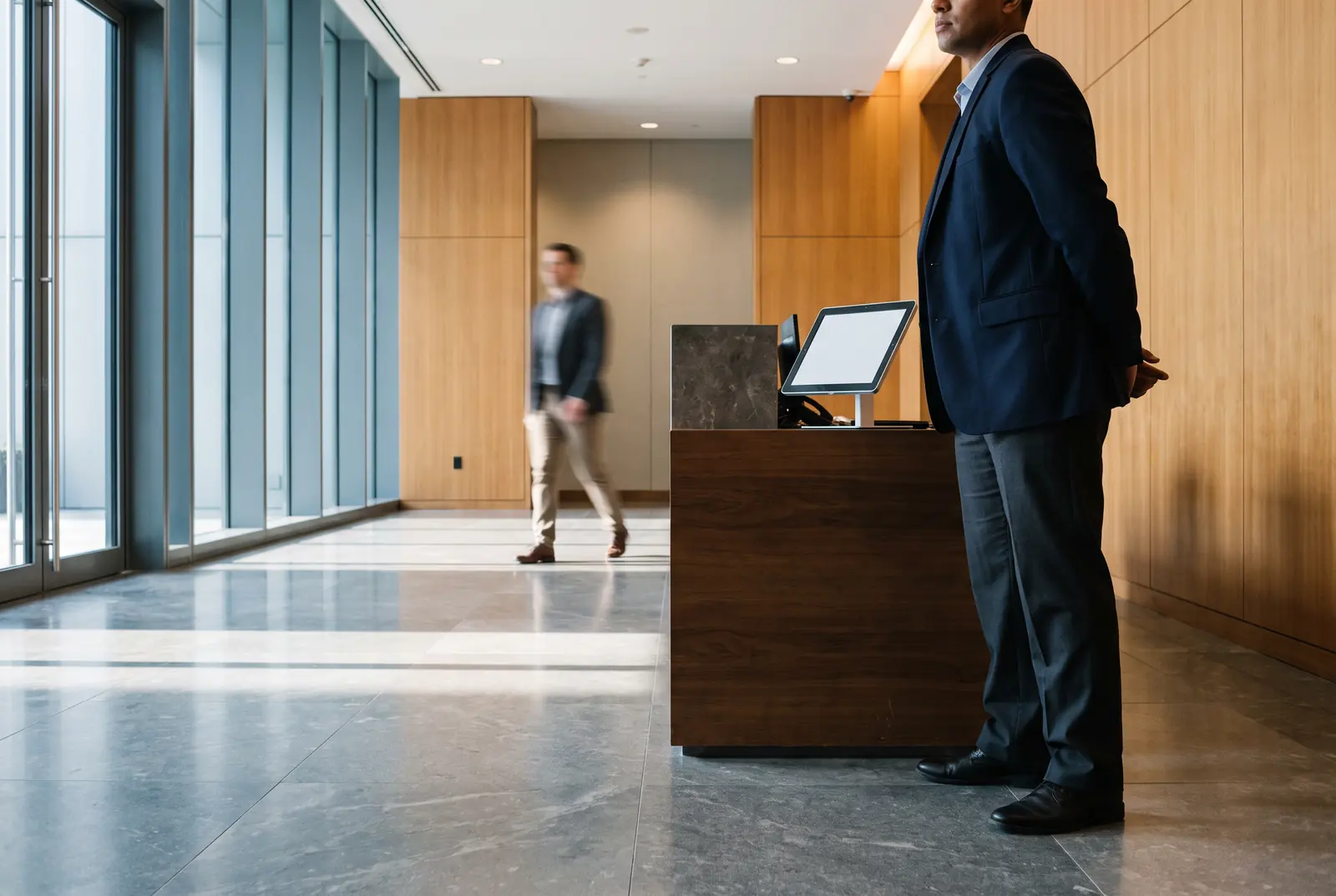
The Front Desk Is Half Security and Half Tenant Relations
In a commercial building the security officer is often the only building representative a tenant's employees and visitors meet, which makes the post a service role as well as a control point.
Property managers tend to measure an office security program by two things: whether the building's access rules are actually followed, and whether tenants complain. Both depend on the same officer at the same desk. The person checking a visitor against the tenant's list is also the person who knows which floor the new law firm moved to, holds the door for the courier with a hand truck, and notices that the contractor signing in at six in the evening is not on the work schedule.
We staff commercial posts with that dual role in mind. Officers control entry, keep the logs, walk the building and garage, and open and close the property on schedule. They escalate workplace incidents to the people the building and its tenants have designated. They write it all down. The result for the manager is a documented record of who came and went and what was found, and for tenants a lobby that runs the same way every day.
What Officers Do on This Assignment
Lobby and Front Desk
- Staffing the lobby desk during business hours or after hours as specified
- Greeting tenants and visitors and giving directions
- Registering visitors and confirming them with the tenant before sending them up
- Issuing visitor badges or temporary credentials where the building uses them
- Monitoring lobby cameras and door alarms where available
Access Control and Employee Entrances
- Checking that employee and side entrances latch and are not propped open
- Verifying credentials for after-hours entry under the building's rules
- Managing elevator or floor access for movers and large deliveries
- Controlling keys and access cards held at the desk, with sign-out records
- Reporting lost credentials and access problems to management
Contractors and Deliveries
- Logging contractors in and out against the manager's work schedule
- Confirming certificates or work authorizations are on file when management requires it
- Recording deliveries and directing them to the loading dock or freight elevator
- Holding or redirecting packages per each tenant's instructions
- Noting after-hours work and confirming the area is secured when crews leave
Patrols, Opening, and Closing
- Perimeter and garage patrols on foot or by vehicle
- Interior rounds of common areas, stairwells, restrooms, and mechanical corridors
- Opening checks: unlocking entrances, lights, and confirming the building is ready
- Closing checks: locking doors, clearing common areas, and setting alarms where assigned
- Reporting leaks, outages, and safety hazards found on rounds
Building Rules, Tenant Instructions, and Post Orders
Commercial post orders have two layers. The first is the building's own rules: hours of operation, after-hours access policy, loading dock procedures, contractor requirements, and the emergency plan. The second is each tenant's instructions for their visitors and deliveries, which can differ widely in a multi-tenant property. We collect both during planning, reconcile them with the property manager, and write a single set of post orders so an officer is not left to guess whose rule applies.
Workplace incidents get their own section. An upset former employee in the lobby, a dispute between tenants, a medical emergency, or a threat reported by a tenant each has a defined path: what the officer does first, who at the tenant and at building management is notified, and when police or EMS are called. Officers document the event in an incident report and do not take part in the tenant's internal employment decisions. Post orders are reviewed when tenants change or the building updates its systems.
Downtown Towers, Office Parks, and Converted Mills
Rhode Island's commercial buildings fall into a few recognizable types, and each changes the post. Downtown Providence has high-rise and mid-rise office buildings and a growing number of mixed-use properties with residential floors above retail and offices, several connected to structured parking. Lobbies there sit on busy public sidewalks near transit and the courts, so the desk manages a steady mix of tenants, visitors, and people who simply walk in. Evening events downtown change who is on the street when the building closes.
Suburban office parks in Warwick, Lincoln, Smithfield, and East Providence are the reverse: low buildings, large surface lots, and few pedestrians. Security there leans on vehicle patrol, exterior door checks, and lot lighting more than on a staffed lobby, and an officer may cover several buildings on one campus. Medical-office buildings add patient traffic and early and late hours to the usual office pattern.
Mill conversions are a Rhode Island specialty. Former textile mills in Providence, Pawtucket, and the Blackstone Valley now hold offices, studios, light manufacturing, and apartments under one roof, with multiple entrances, long corridors, freight doors, and riverside lots that were never designed for controlled access. Rounds in these buildings take longer and post orders need a clear map. Winter storms affect opening checks everywhere, from icy entrances to garages closed for snow removal.
What the Program Includes
- Tenant-facing professionalism — Desk officers are the building's first point of contact and are briefed to act like it.
- Consistent access rules — Visitor, contractor, and after-hours procedures are applied the same way on every shift.
- Complete logs — Visitor, contractor, delivery, and key records are kept in the format management specifies.
- Defined escalation — Workplace incidents follow a written path to tenant contacts, management, and emergency services.
- Opening and closing accountability — Each open and close is recorded with the time and any exceptions found.
- Technology where specified — Use of the building's access, camera, or reporting systems is set out in the post orders.
Availability and limits. Office and commercial security officers are private security personnel with no police powers. They follow the building's and tenants' written instructions and do not make management, leasing, or employment decisions. Coverage and start dates are subject to officer availability, location, and assignment requirements; armed coverage is conditional on licensing, insurance, staffing, and applicable Rhode Island law.
Property Types
- Multi-tenant office buildings
- Downtown high-rise and mid-rise towers
- Mixed-use buildings
- Suburban office parks
- Medical-office buildings
- Mill conversions
- Corporate offices and headquarters
- Parking garages serving office buildings
- Professional and financial offices
- Flex and research space
Related Services and Coverage Areas
This service is often combined with Unarmed Security Guards, Mobile Patrol Services, Parking & Traffic Security, Industrial & Warehouse Security. It is frequently requested in Providence, Warwick, East Providence, Lincoln, Smithfield, Pawtucket, and is available across all 39 Rhode Island cities and towns, subject to staffing and assignment requirements.
Frequently Asked Questions
In smaller buildings, yes, if the post orders set times when the desk may be left and how visitors are handled in the meantime. In larger or busier buildings, a separate rover or scheduled patrol visits usually work better than pulling the desk officer away.
Each tenant's instructions are collected during planning and written into one set of post orders alongside the building's rules. Where they conflict, the property manager decides which applies before the officer ever has to.
The officer follows the escalation path in the post orders: deny access if the tenant has instructed so, notify the tenant contact and building management, and call police if the person refuses to leave or makes threats. The contact is documented in an incident report.
They can, where specified in the post orders and once the building has shown them how its systems work. We do not claim a particular platform of our own; reporting is documented through shift and incident reports in the format you need.
Yes. Many buildings staff the lobby themselves during the day and use security for evenings, overnight patrols, weekends, or opening and closing checks.