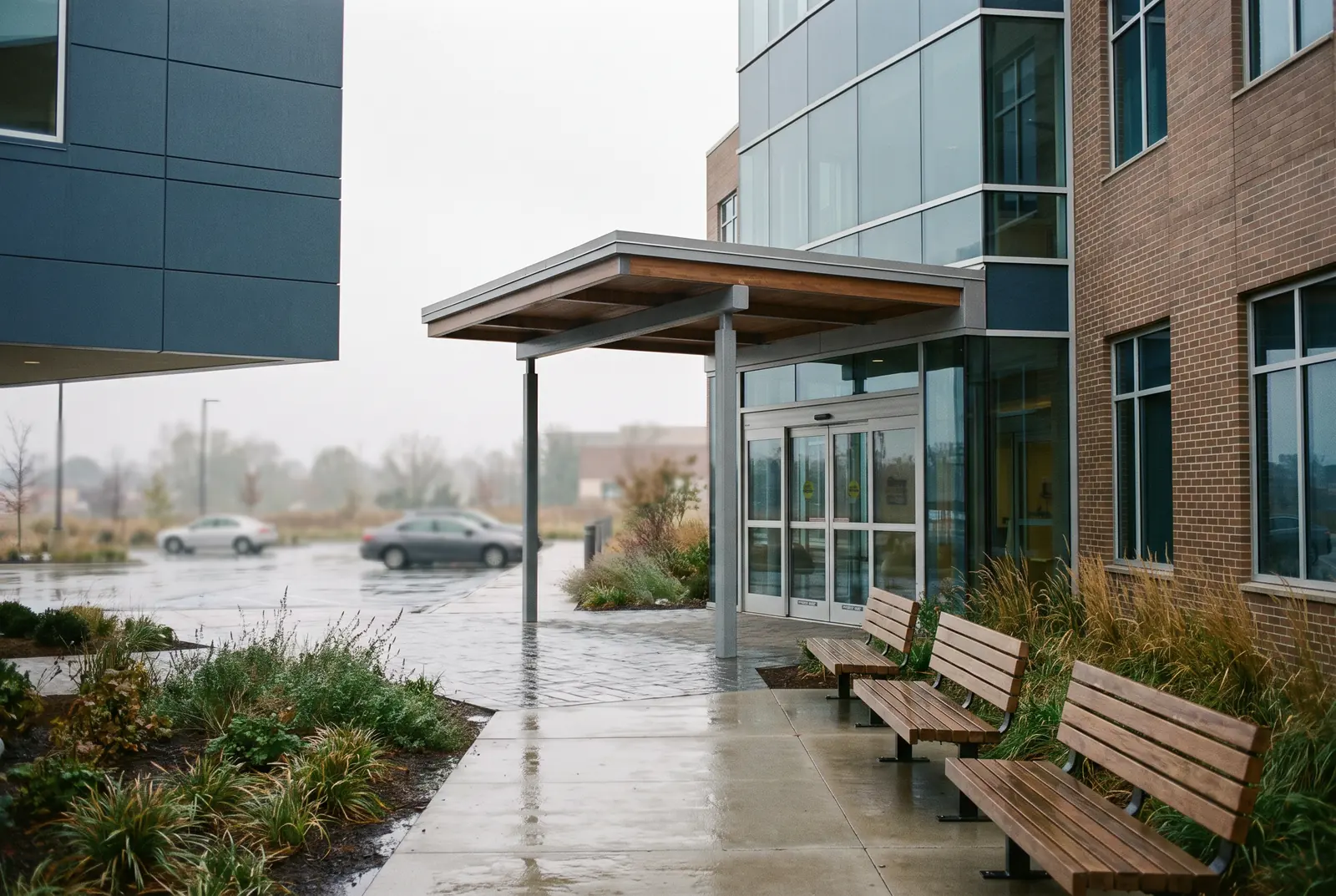
A Supporting Role in a Setting Where Staff Set the Rules
In a medical setting the clinical and administrative staff are in charge, and a security officer's job is to make their work safer and less interrupted.
People arrive at medical facilities anxious, in pain, grieving, or frustrated by a long wait. Most incidents a healthcare security officer deals with are not crimes; they are moments when someone's stress is about to become a disruption. An officer posted at an entrance or waiting area gives front-desk staff a second person to turn to, a visible reason for a raised voice to come back down, and someone whose job it is to notice the side door that keeps getting propped open.
Officers assigned to healthcare sites are private security personnel. They have no police powers and they do not perform clinical tasks or make decisions about patient care. We do not claim healthcare-specific certifications on our officers' behalf. Instead, site orientation covers the facility's own policies, privacy expectations, and emergency codes as provided by the client, and post orders define what the officer does, what is referred to facility staff, and when police or EMS are called.
What Officers Do on This Assignment
Entrances and Visitor Screening
- Greeting and directing patients and visitors at the main entrance
- Screening visitors under the facility's visiting policy and hours
- Issuing visitor badges or sign-in where the facility uses them
- Watching waiting areas and alerting staff to rising tension
- Keeping entrances, drop-off lanes, and ambulance access clear
Restricted Areas and Patrols
- Checking that doors to staff-only, records, and supply areas are secured
- Challenging and redirecting people found in restricted corridors
- Interior rounds of hallways, stairwells, and after-hours suites
- Exterior patrols of parking lots, garages, and building perimeter
- Locking and unlocking doors on the schedule in the post orders
De-escalation and Incident Response
- Responding when staff request a security presence
- Using calm verbal de-escalation with upset patients, family members, or visitors
- Standing by while staff finish a difficult conversation
- Calling police or EMS when a situation exceeds the officer's role
- Writing incident reports with times, people involved, and actions taken
Employee Assistance
- Escorting employees to parking areas at shift change, per post orders
- Being present at staff entrances during late arrivals and departures
- Relaying safety concerns from staff to the facility's designated contact
- Assisting with after-hours access for authorized employees and vendors
Post Orders Built With the Practice Manager or Facility Director
Healthcare post orders are written with the person who runs the building day to day. We ask where incidents have actually happened, which doors must stay controlled, what the visiting policy says, how staff summon help, and what the facility expects an officer to do and not do around patients. The answers produce a written set of instructions covering screening, rounds, staff escorts, and an escalation list that separates matters for the charge nurse or office manager from matters for emergency services.
Privacy is addressed directly. Officers are told what they may log, what they must not record, and how incident reports are delivered so that patient information is handled the way the facility requires. For behavioral health settings the scope is narrower and more carefully defined: officers serve as an observing, supporting presence under the direction of clinical staff and the facility's policies, and some requests may fall outside what we can offer. We would rather say so during planning than discover it on a shift.
Healthcare Sites Across a Small, Varied State
Rhode Island's healthcare footprint is concentrated but not uniform. Providence has a dense hospital district with surrounding medical-office buildings, garages, and hospital-adjacent clinics where foot traffic, parking pressure, and shift changes overlap. Warwick, Cranston, East Providence, and Pawtucket carry a large share of outpatient centers, urgent care, and specialty practices in suburban plazas and converted commercial buildings, often with a single shared lot and no dedicated front-desk security.
Outside the metro area the picture changes. South County and Aquidneck Island see patient volume rise with the summer population, and urgent care waiting rooms in shore towns are busier from June through early fall. Senior living communities in every part of the state have quieter security needs centered on visitor sign-in, door checks, and overnight rounds. Winter storms affect staffing at facilities that cannot close, so coverage plans note how shift relief is handled when travel is difficult.
What the Program Includes
- Staff-directed — Officers take direction from the facility's designated contacts and work within its policies.
- De-escalation over confrontation — The first tool is a calm voice and a visible presence, with police called when a situation warrants.
- Privacy-aware reporting — Logs and incident reports follow the facility's instructions on what is recorded and who receives it.
- Staff escorts — Parking-area escorts and entrance presence at shift change can be written into the post orders.
- Honest scoping — Requests that require clinical training or authority an officer does not have are identified up front.
Availability and limits. Healthcare security officers are private security personnel with no police powers, and they do not provide clinical care or make patient-care decisions. We do not represent that officers hold healthcare-specific credentials; orientation to a facility's policies, privacy expectations, and codes is based on what the client provides. Coverage is subject to officer availability, location, licensing, and assignment requirements.
Property Types
- Medical office buildings
- Outpatient and ambulatory centers
- Urgent care centers
- Community clinics
- Senior living and assisted living communities
- Behavioral health settings
- Hospital-adjacent buildings and garages
- Dental and specialty practices
- Rehabilitation facilities
Related Services and Coverage Areas
This service is often combined with Unarmed Security Guards, Office & Commercial Security, Parking & Traffic Security, Emergency & Temporary Security. It is frequently requested in Providence, Warwick, Cranston, Pawtucket, East Providence, South Kingstown, and is available across all 39 Rhode Island cities and towns, subject to staffing and assignment requirements.
Frequently Asked Questions
The officer's role is to respond calmly, use verbal de-escalation, create space for staff, and call police when the situation requires it. Officers have no police powers, and any role beyond observation and verbal intervention is defined by the facility's policy, the post orders, and applicable Rhode Island law.
We do not claim specific privacy or healthcare certifications. Site orientation covers your facility's privacy expectations and policies as you provide them, and post orders state what officers may and may not record.
Yes, when it is written into the post orders. Escorts are typically scheduled around shift changes and provided on request when the officer can leave the post without creating a gap.
We consider these requests carefully and case by case. Officers can serve as a supporting presence under clinical staff direction, but they are not clinicians, and some assignments may be outside what we can responsibly offer.
Often it is not. Some practices use an officer only during late clinic hours, on particular days, or for a defined period after an incident, and the schedule is set during planning.